Sunday, 10 April 2011
The Last Week
It has been awhile since I wrote in here. I am now in Vilnius trying to settle in. We managed to find a new home in less than a week, what is left now is to find a job and start enjoying a rich cultural life in Vilnius. We are only walking around and looking at posters, but there seems to be numerous galleries and theatres, concerts in churches and concert halls. Vilnius has a vibrant cultural life, much livelier than I remember. I should consider starting a blog about Vilnius and its rich arty pickings. Maybe later. Now I would like to say thank you to all my readers for following me and your kind comments and all support. It's been an intense and very enjoyable cultural year. Good bye!

Tuesday, 1 March 2011
Week 45

It's official! My partner and I are moving to Lithuania. In a month's time! This means very little time left for cultural stuff and even less for this blog. However, I am determined to carry on until the last day.
Before it closed, I visited Shadow Catchers at the V&A a couple of weeks ago. It was quite a small display of camera-less photography. It took a while to get my head around this unusual concept. There is a number of techniques to this sort of photography, but for me they mostly sound like variations of printing. Nevertheless, some of the picture were stunningly beautiful. I particularly enjoyed Pierre Cordier's work. In 1956 he invented 'chemigram' process – a method of directly manipulating photographic paper with light and dyes. Cordier creates abstract metallic images with narratives inside, which unravel stories the longer you look at them.
We gave another shot for Philharmonia Orchestra at the Southbank. Yet again I admired the building and appreciated the conductor directing his orchestra without notes. But a programme of Schumann and Weber works made me snooze again. It's not the orchestra to blame, it just confirms once again that my tastes lie with the 20th century. Give me Shostakovich, Ginatsera and Gershwin. Sorry Bach!
Also last week: highly enjoyed Ian McEan's first novel The Cement Garden. It brought me back to childhood.
Sunday, 13 February 2011
Week 44 - Frankenstein; The Heretic
As I am writing this, the BAFTA awards are on the TV. It looks like a homage to The King's Speech, which was brilliant but it is a pity it takes away any chances from other equally good films. But what really strikes me is the inability of actors to present the nominations. All they have to do is come up on the stage and read the script. But this is exactly what they do – reading it woodenly and making forced jokes.

Yet another play about climate change on London stage opened last week. The Heretic at the Royal Court tells a story of a sceptic scientist at a provincial university. The tensions within the department about her beliefs and a possible funding from pro-climate change corporation are mixed with the family drama and young students' concerns. So there is a case for a great show, especially with Juliet Stevenson in the main role. But the jokes are lame, the other actors are rather weak and static and most of the science on stage is a fairy tale.
 Even higher expectations were for Frankenstein at the National. The adaptation of Mary Shelley's book is directed by Danny Boyle and the cast includes one of my favourites, Benedict Cumberbatch. I saw a preview in which Cumberbatch was playing The Creature (the role is alternated with Johny Lee Miller who was in Frankenstein's shoes that night). He was mesmerising, especially in the opening scene where the monster was given birth. Unfortunately, his performance alone didn't save the night, as nearly everything else was terrible! Other actors were rubbish, decorations simplistic and the narrative beyond boring, although the lighting was fantastic!
 Also this week: a brief visit to the British Museum and a confusing visit looking for art in the Gabriel Orozco exhibition at the Tate Modern.
Sunday, 6 February 2011
Week 43 - Greenland; The Knowledge; King Lear; The King's Speech
Finally, The King's Speech was seen! It is a good movie, but not the best. However, I loved to see many real life people portrayed (amongst others, Churchill, Mrs Simpson, Chamberlain), many actors I saw recently on stage (for example, Derek Jacobi playing Archbishop earlier this week was king Lear on the Donmar stage), fashions and men's haircuts, exquisite décors and the inside life of the royal family.
 King Lear completely sold out even before it started. The main reason for this that it was Jacobi's career defining performance. As you know, I am not a big fan of Shakespeare, but my friend Zois assured me that this was 'a once in a lifetime experience'. So thanks to the Discovery scheme I managed to acquire a ticket last week before the end of the run. In deed, the performances were excellent, and could admire Shakespearian language, but I wasn't gripped.
 I was definitely gripped by The Knowledge at the Bush. A simple story of a new teacher struggling with a difficult class and her career was written so well by John Donnelly and performed brilliantly by the cast, that I didn't want the night to end. The play contains the essential ingredient for a good play about contemporary issues – sharp humour. That is what is lacking in Greenland – a play about climate change written in collaboration by four playwrights at the National. On a bare stage an ensemble of 15 actors show us separate stories of different people something to do with the climate change – eco-warriors, politicians, scientists, etc. There were a lot of moralising and fact-providing, but after two hours I left without any new information or enjoyment of dramatic experience. In fact, I left with a miserable thought that we are all doomed.
Sunday, 23 January 2011
Week 42
Britain's gone crazy over The King's Speech. I was so excited when I saw a trailer for it last year and couldn't wait to see it. Finally in my busy diary there was an easy week and on Wednesday we braved the crowds in the cinema. Please note, that in the UK Wednesday is a 2-4-1 night in cinemas, so they always are packed, as people take advantage of a good deal. But this week the queue was extra long in Islington Vue and as we were midway they announced that all showings were sold out. Instead of a movie we headed for a pub (a wonderful Angelic on Liverpool Road).
 Saturday night at home is a sad thing, so we rushed off to the cinema. Well, King's Speech was again sold out, which is actually not that surprising – all the middle class royalists in Muswell Hill came in droves to see Colin Firth stammering. But all films were sold out for the night! And so we find ourselves in Blockbuster across the road – the most depressing store on the high street. There are lots of third rate comedies and action movies with never-heard-of heroes. We settled on It's Complicated staring Meryl Streep. The trailer looked fun, yet I heard critics slating it. But what do they know – Meryl Streep doesn't do kaka! Unfortunately, this was kaka, so boring with one or two laughs. This is a sort of movie my boss loves – no offence, no deeper meaning, no sense and a happy ending.
 Saturday night at home is a sad thing, so we rushed off to the cinema. Well, King's Speech was again sold out, which is actually not that surprising – all the middle class royalists in Muswell Hill came in droves to see Colin Firth stammering. But all films were sold out for the night! And so we find ourselves in Blockbuster across the road – the most depressing store on the high street. There are lots of third rate comedies and action movies with never-heard-of heroes. We settled on It's Complicated staring Meryl Streep. The trailer looked fun, yet I heard critics slating it. But what do they know – Meryl Streep doesn't do kaka! Unfortunately, this was kaka, so boring with one or two laughs. This is a sort of movie my boss loves – no offence, no deeper meaning, no sense and a happy ending.
 That was all this week. But I have some goodies waiting next week.
Monday, 17 January 2011
Week 41 - When We Are Married; Becky Shaw; BBC SO
 One of the first plays which took me aback was Time and the Conways at the National a few years ago. It is written by J.B. Priestley and since then I always try to see his production on London stage. However, none have yet repeated the awe inspiring feeling. The same applies to When We Are Married currently running at the Garrick Theatre. It did have some good laughs and an amazing set on stage, but the play didn't touch my heart. The cast contained lots of 'local celebrities' (I didn't recognized anyone) who performed well, but boozy singing and old men acting drunk diminished the comedy element.
A much better, actually superb, evening was spent at the Almeida in Islington. After the UK première of Becky Shaw, a satire of contemporary American life, I was left with a feeling equal to that after Time and the Conways long time ago. The action was fast, the characters sarcastic and the ending unpredictable – a perfect recipe for a great modern play.
The week finished with a great concert by the BBC Symphony Orchestra. I am always careful with this SO, as they play a lot contemporary and unknown music to me and very often their concerts can be dull. This weekend the programme sounded like it could one of those. However, it was an evening of discovery and beautiful moving music. They played de Falla, Piazzolla and Ginastera creations. These three composers are from Argentina and Spain and their music contains many ingredients of the southern cultures. I particularly enjoyed Ginastera's Estancia dances, which the orchestra played with real passion.
Monday, 10 January 2011
Week 40 - Deathtrap; Gauguin; Diaghilev

The major autumn gallery shows end in the begging of January and last week I had a lot of catching up to do. On the bank holiday we went to the Tate Modern to see Paul Gauguin, Maker of Myth. A big mistake – not only the end of exhibition, but also a bank holiday means an immense amount of people. A queue to see every painting and by the time you reach the last room you don't really care what's on the wall. All you want is to escape. That could be my New Year's resolution – not to leave until last minute to see exhibitions. Anyway, back to Gauguin. His paintings are pleasant on the eye but none of them struck me as masterpieces. Actually, I wouldn't hang them on my walls. His praised paintings from Tahiti tell a false tale of contemporary times as they illustrate pagan rituals and myths, although at that time Tahiti was already a Christian country.

At the V&A the last days of exhibition on Diaghilev's talents also draw in massive crowds. When Diaghilev started his celebrated Ballet Russes in Paris in 1908, he transformed the world of dance. The exhibition features the costumes, the brochures, the sets and everything looks so luxurious and exotic even to today's audience eyes. The impresario worked with the biggest names of those days – Stravinski, Chanel, Picasso, Satie. After the Great War, when the dance company struggled financially, their annual summer residence in London would provide enough funds for new productions. The crowds at the V&A prove that the British are fascinated with the Russian culture now as much as they were in Diaghilev's days.
Deathtrap is also ending its run at the Noel Coward theatre and I am so happy I managed to get tickets for this comedy thriller with as many twists as laughs in it. The laughs were provided by the magnificent Simon Russell Beale acting and the twists by Ira Levin's writing.
Monday, 3 January 2011
Week 39 - Cinderella; Crazy for Gershwin

Matthew Bourne's Cinderella at Sadler's Wells was a great start to 2011. It was a characteristic Bourne's piece – lots of twists on the plot and fabulous decorations. Just a few examples of the plot twists – the action takes place in the London Blitz, Cinderella in addition to her sisters also has three brothers and her soldier finds her in hospital, not by trying the shoe on every girls' feet. The godmother became a shiny white haired mischievous man, who looked quite off-putting. There were a few fantastic dance movements and clever ideas. For instance, I didn't know there are so many ways to illustrate a clock with the human body. Unfortunately, there also were lots of miming. In fact, the third act was just that. When the lovers found each other, I was expecting a grand love dance, but we just got some flapping on the stage.
During the festive period we had a chance to experience some pop classical music. Critics might dismiss his productions but Raymond Gubbay is a brilliant impresario in bringing classical music to the masses . Crazy for Gershwin at his annual Christmas Festival at the Barbican was a prime example of his talent to please the people. The crowd was mainly the Daily Mail readers with the best of perm hair and fleece jumpers. On the stage a big band played while some second rate singers and dancers tried to impress the crowd. I do love Gershwin, but all this seemed over the top and spoiled the music. Credit is due to Mr Gubbay for getting the people to the concert halls, but for me this experience was enough and I will keep avoiding his productions.
Tuesday, 28 December 2010
The Review of the Year 2010
Oh, what a year it was! I don't think I will ever again have such a packed cultural year, sometimes an event a day. It's been a true pleasure and here are my best of the best:

Venue of the year must be the Barbican. Not every production there is great, but their generous schemes allow to broaden the mind with international theatre and abundance of classical music. And of course, I love the architecture with its mixture of ancient and brutalist.
I must agree with most critics that the National and the Royal Court had superb year with nearly every production on top form and I was lucky enough to catch most of them. Just a few to mention – London Assurance was the funniest play I have ever seen, Laura Wade's Posh explained the roots of the current political establishment, Clybourne Park talked about race like no one before.
The discovery of the year belongs to the National Gallery for it's guided tours – can't get enough of them.
War Horse and Secret Cinema disappointed the most. Secret Cinema is such a great idea, but they outgrew themselves and became a massive disorganised money spinning machine. The puppets at the War Horse were impressive, but the story and everything else is as ordinary as anything in the West End.
 In the art galleries I most enjoyed the splendid Treasures from Budapest at the Royal Academy of Arts and Van Doesburg and the International Avant-Garde at the Tate Modern. While I visited my friend Sima in Rome in February, we saw a fantastic retrospective of Caravaggio's work. When she came over to London, we both loved something a bit more modern – a survey of designer Ron Arad's work at the Barbican.
 My books of the year are Ian McEwan's Amsterdam and Colm Toibin's Brooklyn. One Day by Davis Nicholls was charming and funny and sad – a guilty pleasure.
Tuesday, 14 December 2010
Week 38

Another week, another prize winner book. This week I read Anita Brookner's 1984 Booker prize winner Hotel du Lac. A lyric little story how a woman in her late thirties escapes London to a sleepy Swiss resort and solves her unimportant problems. I appreciated Brookner’s style, but there was so little action and I couldn’t feel sorry for any of the upper middle class characters. Thinking about it, out of all Booker prize winners I read, only a few were great. Mostly the winners are quite mediocre… but maybe it’s just my taste.
Monday, 6 December 2010
Week 37

The winner of the Nobel Literature prize for 2009 is Herta Müller and last week I read one of her books. I never heard of her and the Nobel prize is great to publicise unknown yet brilliant writers. Müller was born in Romania, but spent most of her life in Germany. Even so, her books mostly portrait the grim reality of Nicolae Ceauşescu's regime. The Appointment is not an exception. The book concentrates on a young woman's day while she travels to her appointment with secret police. She was summoned because of sewing notes into the pockets of suits bound for Italy asking recipients to marry her so she could escape the country. The narrative flashes back to her earlier life and little by little we found out about her family, two marriages and friendships. Müller writes like a spider mites its web – unseamlessly the action moves from now and here to the past and memories. The book is a good illustration of people's capability to live with a mad regime.
After the Royal Festival Hall reopened to the public after £111m refurbishment in 2007 I saw Carmen in there, but it was so long ago and I sat so high up with the gods, I forgot how beautiful it is inside. The hall is very spacious and decorated in white, which looks quite minimalistic and clean. The side walls are covered with wavy balconies which to my eyes are the most elegant circle in London theatres and halls. Thanks to the interior of the hall I had something to concentrate on, as the concert by the Philharmonia Orchestra was rather boring. A safe choice of Schuman's symphony left the public unmoved, although it as very impressive how the conductor Christoph von Dohnányi lead the orchestra without notes – he had it all in his head.
Monday, 29 November 2010
Week 36 - Another Year; Treasures from Budapest

I haven't been to cinema for ages, so it was great to watch a movie on a big screen last week, not on our tiny TV. Mike Leigh is one of my favourite directors and his latest feature Another Year has all his trademark attributes. At the centre of the story is Tom and Gerri, a content family of a geologist and councillor living in London suburb and spending weekends in their allotment. Actually, their life seems so idyllic, that it is unreal. Throughout the year various relatives and friends visit their house and most of their lives are grim – much unhappiness, loneliness and overeating. However, for me the friends seemed realistic and human, whereas Tom and Gerry's life was too ordered. The repeated visitor is Gerri's collogue Mary. In her fifties and single, she is putting a brave face and also smiling, but we see that in her friend's home she finds desperately needed company and warmth. The characters are at times too stereotyped and the pace could be slow. It is not the greatest of Leigh's films, but nevertheless, enjoyable.

Treasures from Budapest at the Royal Academy contains some true jewels from the Hungary's Museum of Fine Arts. When one thinks about cities with immense art collection, Paris, Viena and Berlin come to mind, not the smaller states in Central Europe. How surprising to discover that Budapest has a museum to compete on global art tourism market. The collection was started by Esterhazys dynasty, whose members collected art through centuries and donated it to the nation. In London exhibition we are invited to the tour from 14C religious art to 21C modernists. Raphael's icons, da Vinci drawings, Rembrandt's portraits, impressionists and many unseen paintings by Hungarian artists – they all here. How much more treasures were left in Budapest?

Monday, 22 November 2010
Week 35
 Everything's connected. A few weeks ago I read Omega Point by Don DeLillo, in which a character is a film maker. He mentions a movie entirely filmed in one shot and that caught my interest. The film is Russian Ark directed by Alexander Sokurov and released in 2002. It is a poetic excursion around the Hermitage seen through the eyes of the Traveller. He is accompanied by the European. The couple walk from room to room and meet many of the former palace residents (amongst other Catherine the Great and the last Russian tsar Nicholas II). They encounter not only historical figures but also today's tourists. So not much actions here, but what you get more than enough is preaching to the Russians by the European. It all does look poetic, but to the point of being boring. One is left with the notion that the director first thought of creating a film in a single shot and only then decided on the story. All in all, Russian Ark is an appreciative yet failed attempt to create a milestone in cinematography.
The final scene of the movie has a massive ball with live orchestra. It was great to recognise the conductor as Valery Gergiev from the many LSO concerts seen in the Barbican hall. Everything is connected.
Sunday, 14 November 2010
Week 34 - Novecento; Blasted

Some years ago I lived through an Alessandro Baricco phase, reading most of his translated works. Looking back now, I don't think this Italian writer is that great. Nevertheless, a sensation of nostalgia and excitement rippled through me once I got the tickets to his monologue Novecento at the Trafalgar Studios. Novecento is about a great pianist who was born on a liner to America and never set a foot on terra firma. The storyteller is his friend, a fellow musician who is played by Mark Bonnar. Bonnar pulls off the performance well and the one and a half hour flies by, although at times there is too much details and explanations.
 Disturbing. A perfect word to describe Blasted by Sarah Kane revived at the Hammersmith Lyric. Among other cruelties, there is rape, cannibalism and abuse graphically shown on the stage. But the play is disturbing because it leaves you with a wide range of questions. Some are rather technical – What did the playwright mean? Where is the play set? When? What links the characters? And others are philosophical – What is the point of war? What does it mean to be human? What are the limits of love? The play starts with a man and a teenage girl in a plush hotel room. The next morning we find out that there is a war. Maybe it's in the Balkans (but both characters are clearly British)? The hotel room is blasted by the bomb and the man struggles to survive with a soldier. That is the plot in the nutshell. Confusing and disturbing, but it was an interesting form of escapism. It doesn't have to be all West End and happiness, one can escape to hell to appreciated the reality.
 Also this week saw Shun-Kin by Complicite at the Barbican.
Monday, 8 November 2010
Week 33 - The English Patient; Tribes

My good friend Milda never watches a film adapted from a book she has read and vice versa. I think I will follow this rule myself from now on, as too often the movie is not good enough because the book was so much better. This weekend I watched The English Patient, a 1996 epic showered with Oscars. The film tells the story of a forbidden love between a dessert explorer and his sponsor's wife set in the late 1930s. From time to time the plot jumps forward towards the end of WWII where we see the main character badly burnt and trapped in an Italian villa with a bunch of eccentric housemates (a Canadian nurse, a thief with Cavaraggio as a surname and a Sikh kipper). As they try to find out the identity of the mysterious patient, his memory goes back in time and the love story unfolds. It is all tragic and epic with beautiful dessert shots and fabulous frocks. But I couldn't help to compare the movie with the book, especially as there had been so many changes made in plot and in characterization. The most interesting thing is that I didn't enjoy either, but for different reasons. The book was too poetic and the film too slow.
 Mixed feelings after Tribes at the Royal Court. Yet another middle class Jewish family on stage with their not very relevant problems (for example, the Guardian publishing an interview in Society section). Three adult children are back to live with their writer parents. They sit around the table and all just talk, argue and bicker, which is quite funny to watch. All except one, who is deaf. But he seems to be the most sane among them. He brings his deaf girlfriend home, who gets mildly shocked by the family's rudeness, and finally moves out, as the girlfriend helps to get him a job through the deaf community. That is the first act. The second turns all crazy with random kisses, lots of shouting and cheating. After the first act we compared it to intelligent TV entertainment, whereas after the second 'Where Did It All Go Wrong?' was playing in my head.
 Sunday, 31 October 2010
Week 32 - Nearly Ninety; A Week in December

Nearly Ninety was created in the last year of choreographer's Merce Cunningham life before he died in summer 2009. Cunningham is probably the best known American avant garde representative and in his long career he influenced not only the dance world, but a wider culture as well. In his performances dance, music and design all play an equal role on the stage. His last work has all the trademarks of creativity and the name mirrors it (he died nearly ninety). Rigid moves, ballet-like leaps and inorganic relations mix with industrial sounds. I didn't enjoy it but didn't dislike it either – it left an indescribable emotion.
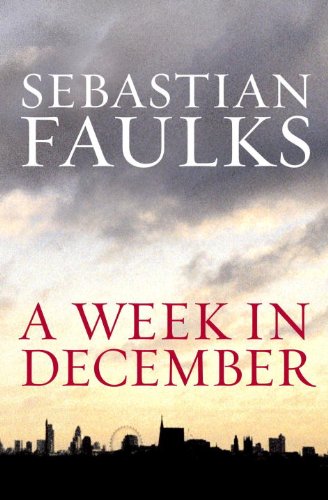 At the monthly book club we discussed A Week in December by Sebastian Faulks. It is a Dickensian novel set in the current day London tracking the intertwined lives of numerous characters. In fact, there are so many characters with back stories, that not much space was left for the action. It is a true 'state of the nation' novel in to which an immense amount of research went in. The book contains detailed descriptions of how the Tube works, of the financial procedures in banks and hedge funds and drug industry among other things. A major fault, however, is the authors decision to invent new names for the items we take for granted and many places in London – Costa café becomes Café Bravo, MySpace – YourPlace, everyone listens to Girls from Behind, not Girls Aloud, etc. What is the point of it?
Also this week: listened to Baroque arias performed by Europa Galante at the Barbican and visited the magnificent Cadogan Hall where Vanbrugh String Quartet performed Beethoven's string quartets and yet again went to the most educating and inspiring guided tour of the National Gallery (everyday 11.30 or 2.30 – highly recommended!).
Sunday, 24 October 2010
Week 31 - Onassis; Men Should Weep
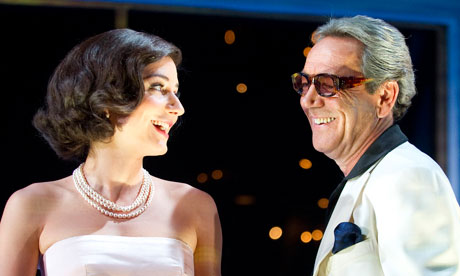
The life of Aristotle Onassis contains all the elements for a gripping play – a larger than life personality, famous lovers (Maria Callas and Jackie O), glamour and money, tragedy (many members of the family died in plane crashes, etc.) and a thriller twist (did Onassis pay for the assassination of R. Kennedy?). However, the just opened Onassis in the Novello theatre is a flop and a great performance by Robert Lindsay does not save it. Most of the action is narrated by Aristo's friend and business partner Kosta, but one does not want to be told what happened, one wants to see it on the stage. And that together with the flowery language of other characters left me longing for the end.
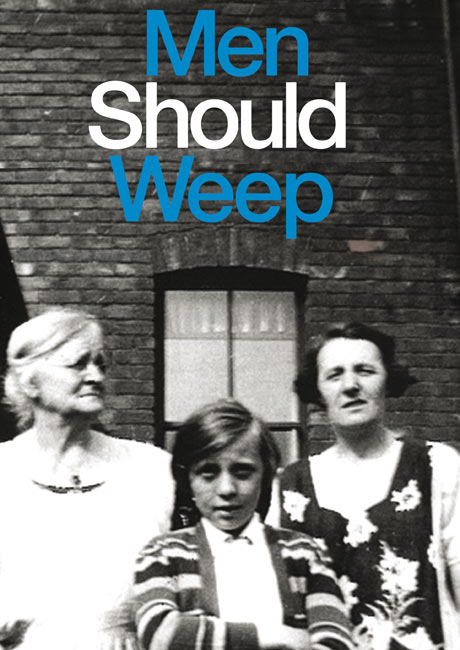 I will remember Men Should Weep at the National for two reasons – one of a great show and another of the ignorance and, ehem, stupidity of some people. The premise is simple – a very poor Glaswegian family in the 1930s depression, where men are looking for jobs and women are left holding the family together. The main character Maggie struggles to cope with her children's problems, with nosey neighbours and the mess in the flat. But along with all the poverty and hardship, there is hope, humour and a fabulously extravagant stage set. Since the play is set in Glasgow, the accents were really strong and it took a while to fully comprehend. At the interval a woman next to me asked if I am Scottish, because she was amazed I could follow the plot. But the top gag of the evening was being whispered behind me. An overheard conversation by two respected-age English ladies: 'I just don't understand why do they have to speak Scottish. We are in London, so they should speak English or at least have the subtitles'. I could not believe my ears.
Also this week: enjoyed Design for Living at the Old Vic with splendid sets.
Sunday, 17 October 2010
Week 30 - The Double Issue
 Do you know that special feeling when you start a book and from the first page you are absorbed and know that every page will be fantastic and the more you read the better it gets? You want to get lost in that world, for the book never to end. The book has everything you most value and most enjoy. Oh, that is the best feeling in the world and I haven't experienced it for a long time. But the wait was over last week as Amsterdam by Ian McEwan consumed my total attention for few days. The story is about a true friendship of two men – a composer and a newspaper editor. The author provides a wealth of background information on how things work in an orchestra and a daily's office, which added an enormous amount of pleasure to the clean language and brilliant observations of today's world. I was tired of reading average books and so Amsterdam was pure satisfaction.
One of the last Arthur Miller's play Broken Glass just opened at the Tricycle. It's a fantastic production with brilliant acting, especially by Anthony Sher. He is a respected businessman whose wife's legs suddenly get paralysed after she sees reports of Kristallnacht (this is 1938). As the play goes on, we discover that there might be another reason and not all is good under the calm facade of their marriage. As it is typical to Miller, there is a lot of humour and analysis of being a Jew in his play. But above all, we witness the pain an enormous love can bring to people.
Broken Glass was the best of the five performances I saw last week. The rest were mostly dreadful. Whilst waiting for the end, I fell asleep during Danton's Death at the National. A false blessing that there was no interval – not a long play, but I could have left on the break.
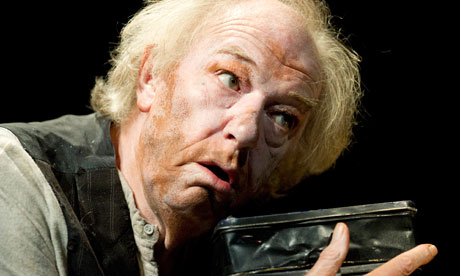
Krapp's Last Tape – allegedly Beckett's masterpiece with Britain's best living actor Micheal Gambon. It was another 50 minutes of torment. The recorded text wasn't very clear and jokes with banana as a penis were just cheap... As the playwright John Osborne rightly suggested – Tape's Last Krapp...
A little better was TEOREMAT from TR Warszawa (I saw their 4.48 Psychosis in March) at the Barbican. A theatrical revamp of the 1960s Italian film Teorema about a stiff family whose ordered daily life is distracted by an exciting stranger turning up at the door one day. The production had smart styling, interesting ideas, bare staging and good acting. However, it was way too long and the poetic moral in the end lost me.
Also this week I disliked Handel's opera Radamisto at the English National Opera. Why? Handel's music isn't my cup of tea, but I gave it a try. It is quite simplistic, the plot in the opera is silly and the decision to put one of the characters into a fat suit totally ruined it for me. I couldn't stand the distracting comical element that the fat suit provided.
All in all, a super busy week, but only few gems.
Sunday, 10 October 2010
Week 29 - Enlightenment; Blood and Gifts

The Hampstead Theatre just started its first season under the new artistic director Edward Hall with Enlightenment written by Shelag Stephenson. This season is meant to turn around the fortunes of the theatre which in the last few years lost it's track (not difficult to do that after grandees like Mike Leigh and Harold Pinter worked in the glory years). And what a weak start Enlightenment is! The story is intriguing enough – Adam has gone missing on his gap year travels, his middle class parents are in agony until he returns with memory loss. It turns out that the returnee is not their son and a pile of lies unfold while we find out what happened to the real Adam. However, it is ruined by flat acting (a wife slaps her husband and he just goes on talking – no reaction at all), clichéd characters (a psychic for humour element, an over enthusiastic and slightly dumb TV producer, a swearing former Labour minister) and fatigued moral message (we are good only when it suits us). Hopefully the season will get better once Mike Leigh comes back to direct Ecstasy in March.
 The National yet again did not disappoint. Blood and Gifts by J T Rogers was a perfect political thriller. A young and eager CIA agent is sent to Pakistan to help the Afghans to fight the Soviets in 1981. Through his story the audience get to see the corruption of the Pakistani army chiefs, the humanity of the Soviet ambassador, the British inability in the special relation and the motives of the Afghan war lords. The play explains what happened in the ten years war that exposed the weakness and lead to the ruin of the Soviet Empire. Blood and Gifts is brilliant because we see many allusions to today's fight and the main character's personal story is interlinked with the happenings in the world.
Also this week: finished The English Patient by Michael Ondaatje, enjoyed a super educational and inspiring tour of the National Gallery (daily at 11.30 and 2.30 – can't recommend enough!) and watched a dance performance Monger by Barak Marshall at the Barbican.
Sunday, 3 October 2010
Week 28 - War Horse; Or You Could Kiss Me

That leads to another play by the same company, just previewed at the National, Or You Could Kiss Me. It is a story of a gay couple in old age reminiscing of their youth in the 1970s South Africa. in the present, they are bickering at each other, in the past - being shy and afraid even to kiss. However, in the end we do not find out why their relationship is so bitter. The puppets were scary and the puppeteers were particularly distracting. The play was constantly interrupted by the 'story teller', who controlled the plot and acted all supporting roles. As the end approached, I was wondering if there is anything I liked about this play. The answer: not a single thing.
Also this week: The Slap by Christos Tsiolkas divided us the monthly book club - for some it is an engaging society portrait, so other - a predictable unworthy read. Also, indulged myself in the Mediterranean sun and Malaga's old town.
Subscribe to:
Posts (Atom)
